
Geeta Castelino
Executive Director,
KalaGhoda Ass; Educationist, Advisor, Textile & Garment Industry / Inst.
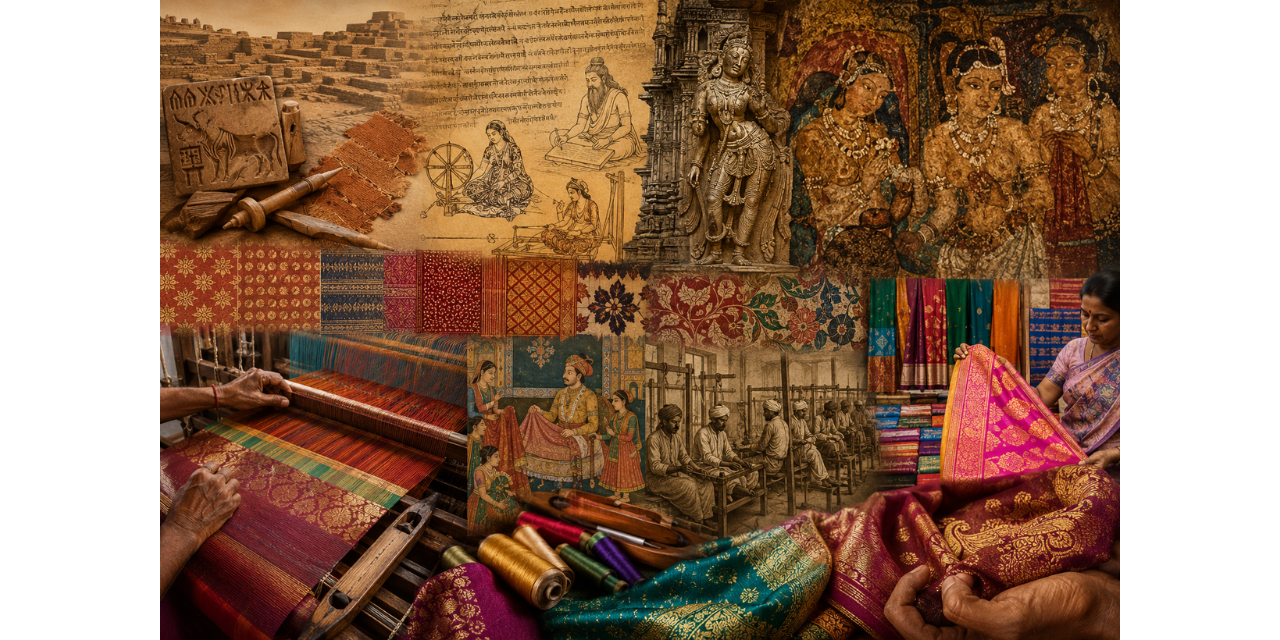
Of all the Arts & Crafts of India, her traditional hand-spun & hand-woven textiles are probably the oldest, as the finds of fragments of finely woven & madder -dyed cotton fabrics and shuttles at Mohen Jo Daro of the Indus Valley Civilisation of the 3rd Millennium BC go to prove. Perhaps hand spinning & weaving were the products of the weavers of India, which have been rightly called ‘exquisite poetry in colourful fabrics’. In the hymns of the Rigveda, there are subtle references to the technique of weaving; the code of Manu too makes frequent references to the crafts of weaving and dyeing. By the time of the Epics, the technique of the loom & its art must certainly have reached a high stage of perfection
In the two great classics, The Mahabharata and The Ramayana, woven cotton, silk and woollen fabrics are frequently mentioned. The temple sculptures of ancient times feature women garbed in brocaded clothes, embroidered fabrics and fine muslins. The magnificent frescoes of the Ajanta cave complex reveal many kinds of garments… in these frescoes, as also in those of the Bagh caves, there are signs of many different kinds of weaves and textiles – like the Bandhani, figured muslins and rich brocades. Revealed here are the garments with stripes, circles, checks, chevron and other geometrical patterns, along with conventionalised floral motifs and intertwining scrolls with birds and beats. There is a detailed account of the country of the time at the court of Chandragupta Maurya, of how the Indians of those days were garbed in the finest flowered muslins and the rich and ruling classes in long robes magnificently embroidered in gold thread with precious stones. The years rolled by; in the 14th century, Mohammed Tughlaq employed over 500 expert weavers in Delhi to weave silk and gold brocades to be presented as gifts and for the ladies of the royal court.
And today, there is perhaps hardly a village in this vast subcontinent where there is no colony of handloom weavers, each member sitting beside his simple loom, weaving the traditional beauty of India’s own precious heritage.
Year after year the craft of the hand-loom is slowly dying out, unable to compete economically with advancing technology and the high speed of powerlooms from which gush out thousands of yards of fabrics, day after day, to clothe the poor and the rich alike. But now and then one still comes across the beautiful textiles of traditional designs that can soothe and excite, art fabrics for the discerning few.
Although there is a current flicker of interest in handloom textiles, ‘The social changes in the country, the modern outlook and changes in dress and the concentration on simplicity rather than on the grandeur associated with silk woven and gold laced clothes and, above all, the economic factors, have all contributed towards decreasing the demand for hand woven textiles. The beautiful textiles of old, the lovely traditional designs, may continue to be produced … thanks to those reviving the traditional handlooms.. like Mumbai’s Kala Ghoda Association (an NGO) through its most sought-after annual Kala Ghoda Art Festival for the past 26 years where artisans from different remote villages of the States of India are being promoted to showcase the handlooms & have a direct market to their products, where there is no middleman involved and which also gives them the financial boost and confidence they deserve. We at KGA work with craftsmen & promote their talent through the Art Festival for a direct market for the artisans.
The Creative Process of the handloom weaving is so rhythmic and precise with their Traditional motifs .. it is magic … past 26 years we at Kala Ghoda Art Festival have opened a market for the craftsmen, guided them with design development without loosing their originality yet getting them a platform to create something unique which the customer requires..making the handlooms more sought after with giving a touch of contemporised version thru development yet keeping the rich traditional, attractive and intricate look to their product.
Every handloom product brings to light the story of a region, a community and the countless people associated with it. These are the people, the artisans, who proudly preserve India’s cultural heritage. We must strengthen the spirit of Vocal for Local and help them to sustain the art & make them financially independent to spread the art to the world, which people are always looking for to be in their possession.