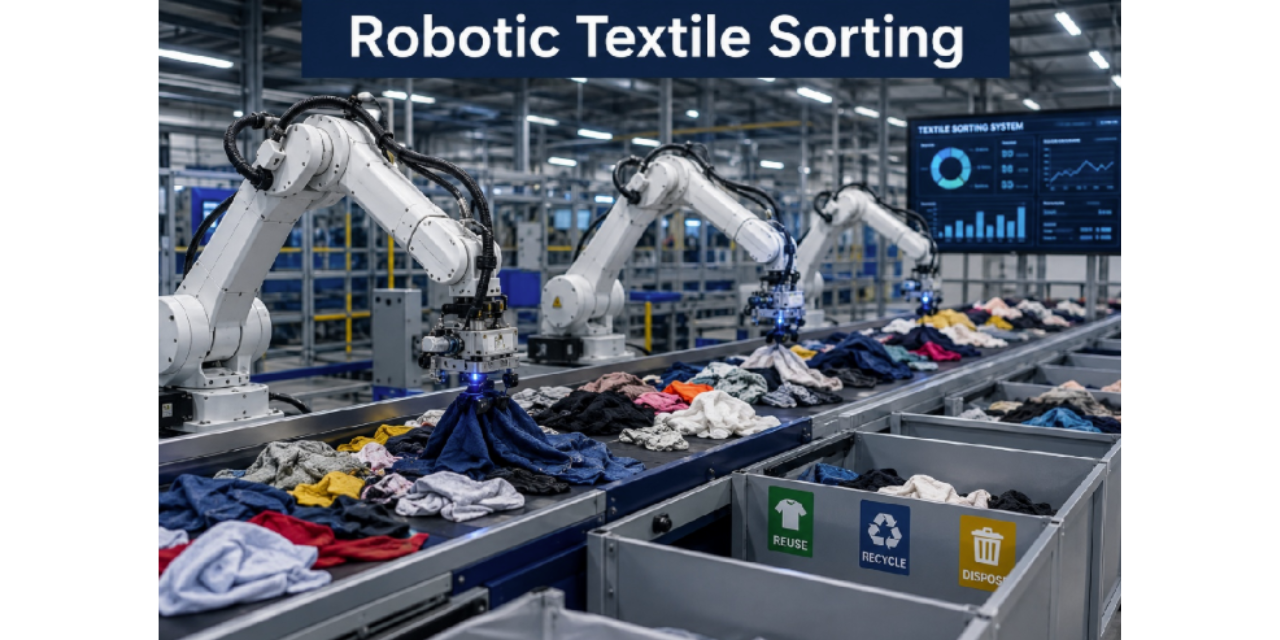
The global Robotic Textile Sorting Market is expected to grow significantly, reaching USD 1.12 billion by 2034 from USD 400.1 million in 2025, registering a CAGR of 12.1% during the forecast period. The market’s expansion is being fuelled by increasing adoption of automation in textile recycling, manufacturing, and waste management, alongside growing regulatory support for sustainable textile practices.
As global textile production and consumption continue to rise, managing post-consumer garments and industrial textile waste has become a major challenge. Traditional manual sorting methods are increasingly unable to handle the growing volumes and complexity of textile waste, creating strong demand for robotic textile sorting technologies powered by artificial intelligence (AI), computer vision, robotics, machine learning, and advanced material recognition systems.
Unlike conventional sorting processes, robotic systems can rapidly identify fabric composition, colours, fibre blends, garment types and contaminants. These intelligent solutions improve sorting accuracy, increase recovery of reusable textiles and recyclable fibres, reduce operational costs, and enhance overall recycling efficiency. Technologies such as near-infrared (NIR) spectroscopy, hyperspectral imaging, cloud-based analytics, and advanced robotic arms are transforming textile recycling operations worldwide.
The technology is finding applications beyond recycling facilities, with growing adoption among fashion brands, industrial textile manufacturers, charity organisations and municipal waste management companies. Automated textile sorting supports circular fashion initiatives by improving fibre purity, reducing landfill waste and enabling high-quality recycled materials for new product manufacturing.
Several long-term trends continue to support market growth, including rising textile waste generation, increasing demand for recycled fibres, labour shortages, investments in smart recycling infrastructure, sustainability commitments from fashion brands, and stricter government regulations promoting textile recycling and circular economy practices.
Looking ahead, the next generation of robotic textile sorting systems is expected to incorporate AI-powered fabric recognition, digital garment passports, autonomous mobile robots, blockchain-enabled material traceability, edge computing and fully autonomous recycling facilities, further improving efficiency and sustainability across the textile value chain.
The competitive landscape includes companies such as Tomra Systems ASA, Valvan Baling Systems, Andritz AG, Siemens AG, ABB Ltd., Rockwell Automation, Schneider Electric, SoftWear Automation, Worn Again Technologies, Bollegraaf Recycling Solutions, PICVISA Machine Vision Systems, Pellenc ST and Stadler Anlagenbau GmbH, among others. The report also highlights significant investment opportunities across AI-powered material recognition software, smart robotic manipulation systems, textile recycling automation platforms, cloud-based recycling management solutions and digital traceability technologies.