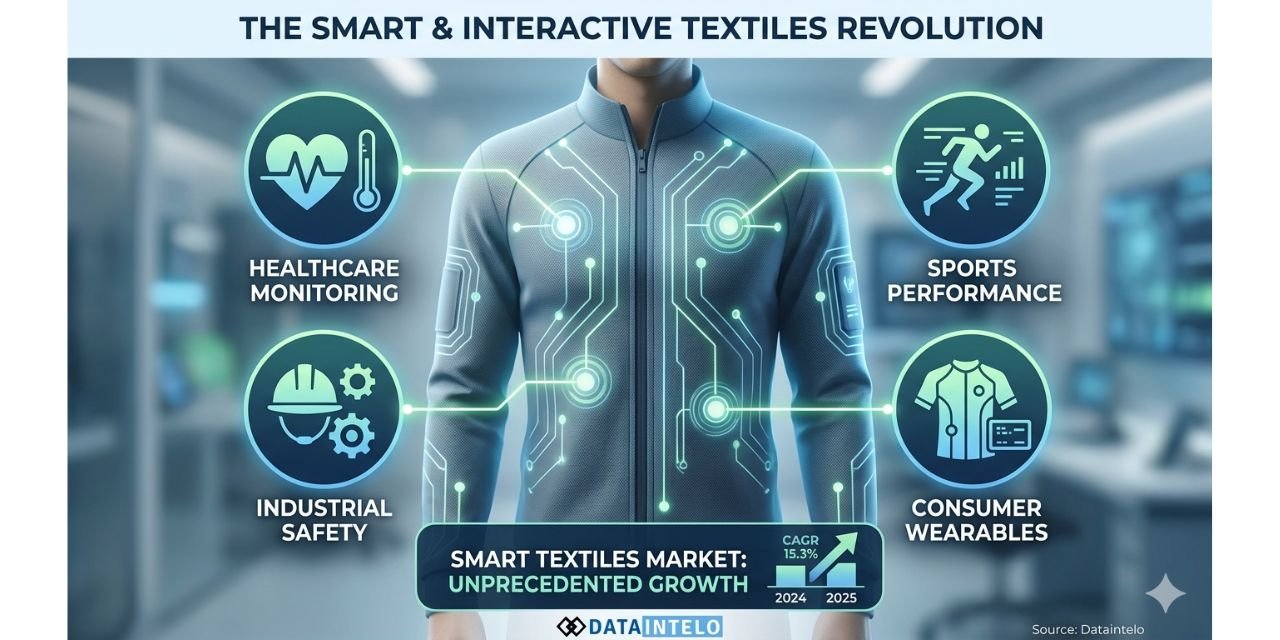
The smart and interactive textiles market is witnessing rapid expansion, fuelled by advancements in wearable electronics, sensor-integrated fabrics, and responsive materials. According to Dataintelo, the global market was valued between USD 3.35 billion and USD 5.2 billion in 2024 and is expected to grow to USD 5.2–9.61 billion in 2025, reflecting strong year-on-year growth. The sector is projected to maintain a CAGR of 15.3% between 2025 and 2032, with long-term forecasts indicating a CAGR of 24.9% through 2035, reaching approximately USD 48.6 billion.
Understanding Smart and Interactive Textiles
Smart textiles, also known as e-textiles, integrate digital components such as sensors, conductive fibres, actuators, and microchips. These enable real-time monitoring, adaptive responses to environmental stimuli, and data transmission for enhanced user interaction. Applications span across healthcare, sports, defence, industrial safety, transportation, and fashion.
Market Growth and Key Metrics
The market demonstrates consistent high-growth patterns:
- 2024: USD ~3.35–5.2 billion
- 2025: USD ~5.2–9.61 billion
- CAGR (2025–2032): ~15.3%
- CAGR (2025–2035): ~24.9%
This indicates a multi-fold expansion, with projections suggesting up to 9x growth over the next decade.
Segment Insights
Product Share (2025):
- Wearable electronics dominate with ~57.3% share
- Other smart materials account for ~42.7%
Application Share (2025):
- Industrial applications lead with ~42.6%
- Transportation and other sectors continue to expand steadily
Regional Performance
- North America holds ~28.1% market share in 2025
- Europe is projected to reach ~USD 2.8 billion with a CAGR of ~12.8%
- Asia Pacific is the fastest-growing region with ~32% CAGR
- India is expected to grow at ~25.4% CAGR between 2025 and 2035
Cost and Technology Dynamics
Smart textiles involve higher production complexity:
- Costs are typically 2–4 times higher than conventional fabrics
- Sensors and conductive fibres account for up to 35% of production costs
- Leading companies invest USD 300–500 million annually in R&D
Performance benchmarks highlight:
- Sensor reliability up to 95% uptime
- Response latency under 50 milliseconds
- Battery life ranging from 8 to 72 hours
Benefits Across Industries
Healthcare:
- Monitoring accuracy up to 98%
- Hospital readmission reduction of 10–15%
Industrial Safety:
- Up to 30% reduction in workplace risks
- Productivity gains of 8–12%
Real-World Applications
- Smart healthcare wearables show up to 99% real-time data capture and 87% detection sensitivity
- Sports applications improve recovery time by 22% and training outcomes by 18%
Challenges
Despite strong growth, the market faces key constraints:
- Production costs up to 4 times higher than traditional textiles
- Durability concerns with 15–30% shorter lifespan
- Compliance and certification adding 20–35% additional costs
Future Outlook
Projected growth remains robust:
- 2026: USD ~7–10 billion
- 2030: USD ~21–26 billion
- 2035: USD ~48.6 billion
The sector is expected to scale rapidly across industries, driven by technological convergence and increasing adoption.
Conclusion
Smart and interactive textiles are evolving into a major innovation-driven segment within the global textile industry. With strong CAGR projections, expanding applications, and measurable performance benefits, the market is set to transform how textiles interact with users and environments, positioning itself as a key driver of future-ready materials.
Read A Full Report:
https://dataintelo.com/report/smart-and-interactive-textiles-market-report