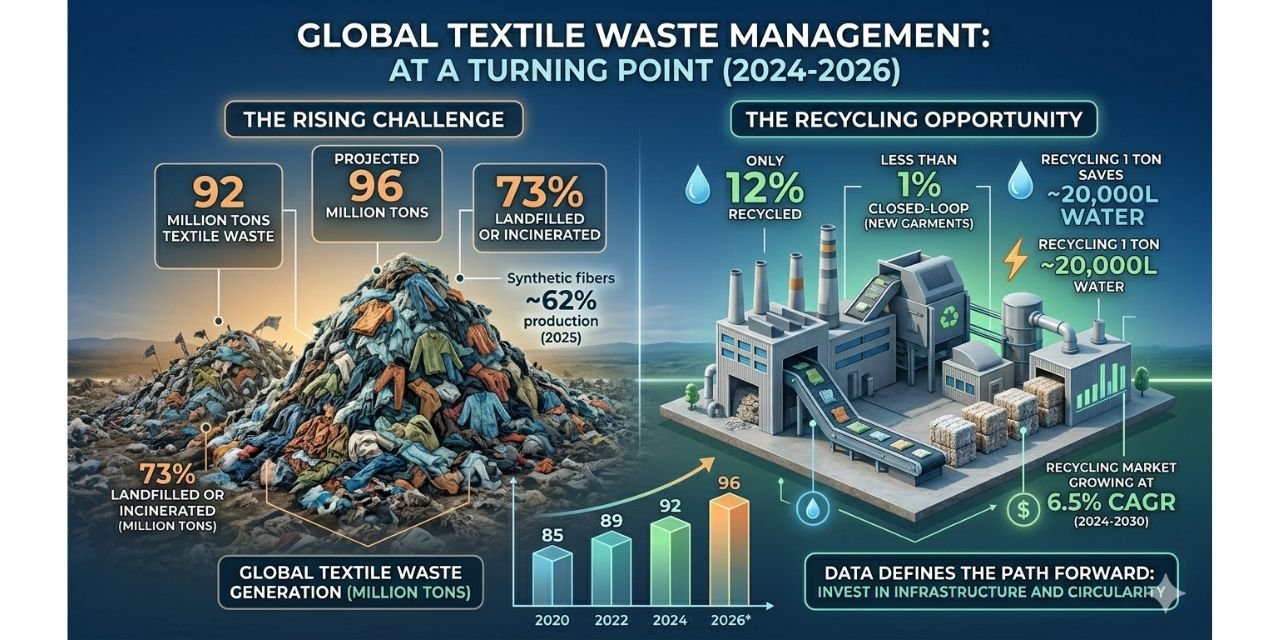
The global textile industry is facing a critical sustainability challenge, with textile waste reaching approximately 92 million tons in 2024 and projected to rise to 96 million tons by 2026. Driven by fast fashion consumption, limited recycling infrastructure, and increasing reliance on synthetic fibres, textile waste has become both an environmental and economic concern.
Key Statistics Snapshot
- 92 million tons of textile waste generated globally (2024)
- Projected 96 million tons by 2026
- 73% of waste landfilled or incinerated
- Only 12% recycled; less than 1% reused for new garments
- Textile industry contributes nearly 10% of global CO₂ emissions
- Synthetic fibres account for around 62% of total production
- Recycling 1 ton saves approximately 20,000 litres of water
- Disposal costs range between $75–$150 per ton
Rising Waste Volumes (2020–2026)
Textile waste has steadily increased from 85 million tons in 2020 to an expected 96 million tons by 2026, reflecting a 13% rise over six years. Developed countries generate significantly higher per capita waste (20–25 kg annually), while emerging markets average 8–10 kg.
Key Drivers Behind the Growth
- Fast Fashion Expansion: Production has doubled since 2000, while garment usage has declined by nearly 50%
- Low Recycling Rates: Only 12% of textiles are recycled, with minimal closed-loop systems
- Synthetic Fibre Dominance: Polyester production continues to rise, with long decomposition cycles
- Consumer Behaviour: Around 85% of textiles are discarded instead of reused
- Infrastructure Gaps: Limited formal recycling systems globally
Environmental Impact
- Carbon Emissions: Approximately 1.2 billion tons of CO₂ annually
- Water Consumption: Around 2,700 litres required for a single cotton shirt
- Pollution: Textile dyeing contributes nearly 20% of industrial water pollution
- Landfill Impact: Accounts for 5% of global landfill waste
- Microplastics: 35% of ocean microplastics originate from textiles
Waste Management Approaches
- Recycling: Reduces energy use by up to 90% and cuts emissions significantly
- Reuse & Resale: Extending garment life lowers environmental impact by 20–30%
- Mechanical Recycling: Cost-effective but limited in fibre reuse cycles
- Chemical Recycling: High efficiency but higher costs
- Waste-to-Energy: Converts waste into usable energy with moderate efficiency
Cost Comparison
- Landfill: $75–$100 per ton (high environmental impact)
- Incineration: $100–$150 per ton
- Mechanical recycling: $120–$180 per ton
- Chemical recycling: $200–$350 per ton
Despite higher upfront costs, sustainable methods can reduce long-term environmental and regulatory costs by up to 60%.
Market Trends and Forecast
- Market size expected to grow from $7.5 billion (2024) to $11.2 billion by 2030
- CAGR of 6.5% between 2024 and 2030
- Asia-Pacific leading growth, followed by Europe and North America
- Global targets aim for 50% textile recycling rates by 2030
Benefits of Textile Waste Management
- Up to 50% reduction in landfill waste
- Water savings of 20,000–25,000 litres per ton
- Energy savings of around 70%
- Emission reductions of 30–40%
- Revenue potential of $500–$1,000 per ton recycled
- Job creation across recycling ecosystems
Key Challenges
- High sorting costs (30–40% of total recycling cost)
- Blended fabrics limiting recyclability
- Low collection efficiency (~25%)
- Limited consumer awareness globally
Future Outlook
By 2030, textile waste could reach 110 million tons. However, recycling rates are expected to improve to 25–30%, supported by innovations such as AI-driven sorting and circular economy models that could reduce waste generation by up to 20%.
Conclusion
The textile waste challenge is defined by scale, but also by opportunity. Increasing recycling rates, extending garment lifecycles, and investing in infrastructure can significantly reduce environmental impact while unlocking economic value. Data clearly indicates that sustainable transformation is not only necessary but achievable.