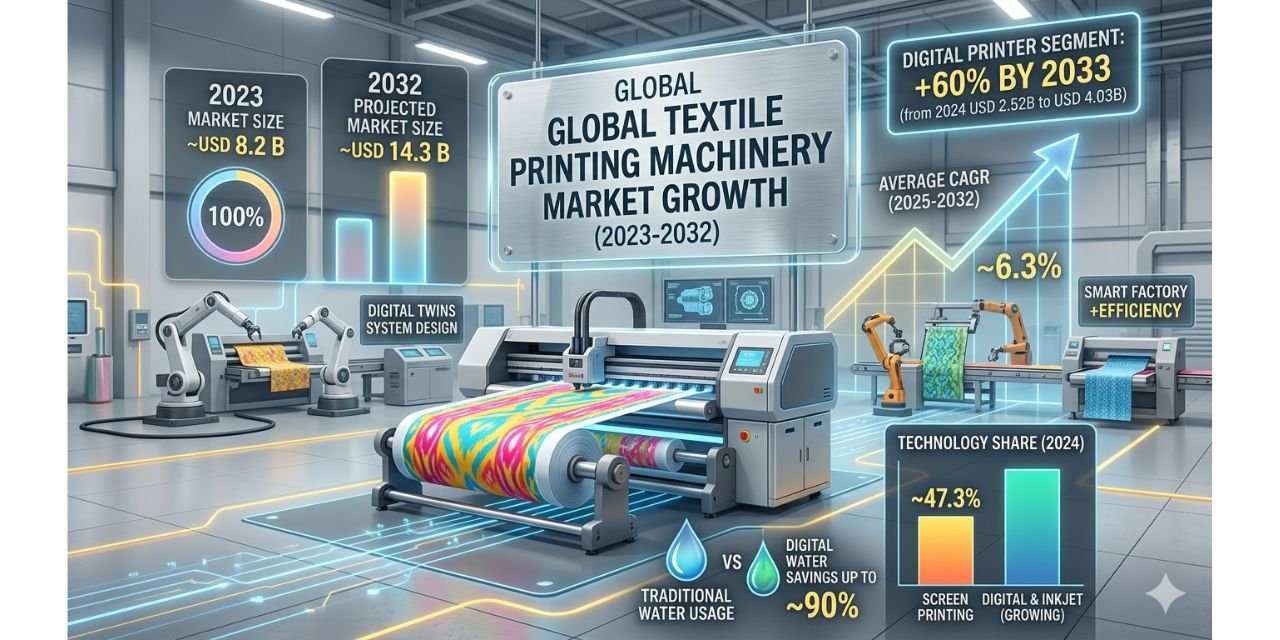
In 2026, textile printing machinery continues to play a critical role in enabling global textile manufacturing, spanning garments, home textiles, and technical fabrics. According to Dataintelo, the market was valued at approximately USD 8.2 billion in 2023 and is projected to reach around USD 14.3 billion by 2032, registering a CAGR of about 6.3% between 2025 and 2032. This growth reflects the increasing integration of advanced technologies, efficiency improvements, and sustainability-driven investments across the sector.
Key Statistics at a Glance (2021–2033)
- 2023 Market Size (Machinery): ~USD 8.2 billion
- 2032 Projected Market Size: ~USD 14.3 billion
- CAGR (2025–2032): ~6.3%
- Textile Printing Market (2024): USD 25.8 billion
- Projected Textile Printing Market (2033): USD 56.7 billion
- Digital Printer Segment (2024): USD 2.52 billion
- Digital Printer Forecast (2033): USD 4.03 billion
- Asia Pacific Share (2024): ~37.6%
- Screen Printing Share (2024): ~47.3%
- Roll-to-Roll Printing Share (2024): ~66.9%
- Water Savings (Digital vs Traditional): Up to ~90%
Market Growth & Regional Trends
The textile printing machinery sector has shown strong momentum over recent years. From a base of USD 8.2 billion in 2023, machinery demand is expected to grow by nearly 74% by 2032. The broader textile printing industry reached USD 25.8 billion in 2024, signalling strong downstream demand.
Asia Pacific remains the dominant regional market, accounting for approximately 37.6% of total share, with similar strength in digital printing adoption. Meanwhile, the U.S. and Europe continue to invest heavily in automation and high-efficiency systems.
Technology Landscape & Efficiency Gains
Screen printing continues to lead with a 47.3% market share, but digital and inkjet technologies are rapidly expanding due to rising demand for customisation and short production runs.
Within digital printing:
- Roll-to-roll systems dominate with a 66.9% share
- Digital processes can reduce water usage by up to 90% compared to traditional methods
These advancements are not only improving sustainability metrics but also significantly lowering operational costs.
Cost Structure & ROI Insights
Investment levels vary significantly by technology:
- Traditional screen printing systems: USD 150,000–250,000+
- Single-pass digital printers: USD 300,000–500,000+
- High-throughput digital systems: USD 800,000–1.2 million+
A mid-sized manufacturer investing in a digital printing system (~USD 500,000) can achieve:
- 25–45% reduction in per-unit printing costs within two years
- Faster turnaround and reduced labour dependency
Expanding Applications Across Segments
Textile printing machinery serves multiple high-growth segments:
- Garments & Apparel: Accounts for over 40% of deployments
- Home Textiles: Increasing use in furnishings and décor
- Technical Textiles: Growing adoption in automotive, medical, and protective applications
The demand for personalised and functional textiles continues to drive machinery upgrades across these categories.
Future Outlook & Growth Drivers
The industry outlook remains strong:
- Overall machinery market projected to grow at ~6.3% CAGR
- Digital textile printing segment expected to grow ~60%, reaching USD 4.03 billion by 2033
Adoption of digital technologies is expected to rise by 15–25% by 2030, driven by sustainability regulations, cost efficiency, and demand for flexible production.
Measurable Performance Benefits
Upgrading to advanced machinery delivers clear operational advantages:
- 30–50% faster production speeds for complex designs
- Up to 90% reduction in water consumption
- 30–60% reduction in material waste for short-run jobs
Conclusion
The textile printing machinery market in 2026 is defined by measurable performance, sustainability, and digital transformation. With market value expected to grow from USD 8.2 billion in 2023 to USD 14.3 billion by 2032, and digital technologies driving efficiency gains of up to 90% in resource use, the sector is undergoing a significant shift.
These data-backed insights highlight a clear direction: investment in advanced, sustainable, and automated machinery is no longer optional but essential for long-term competitiveness.
Read A Full Report: https://dataintelo.com/report/textile-printing-machinery-market