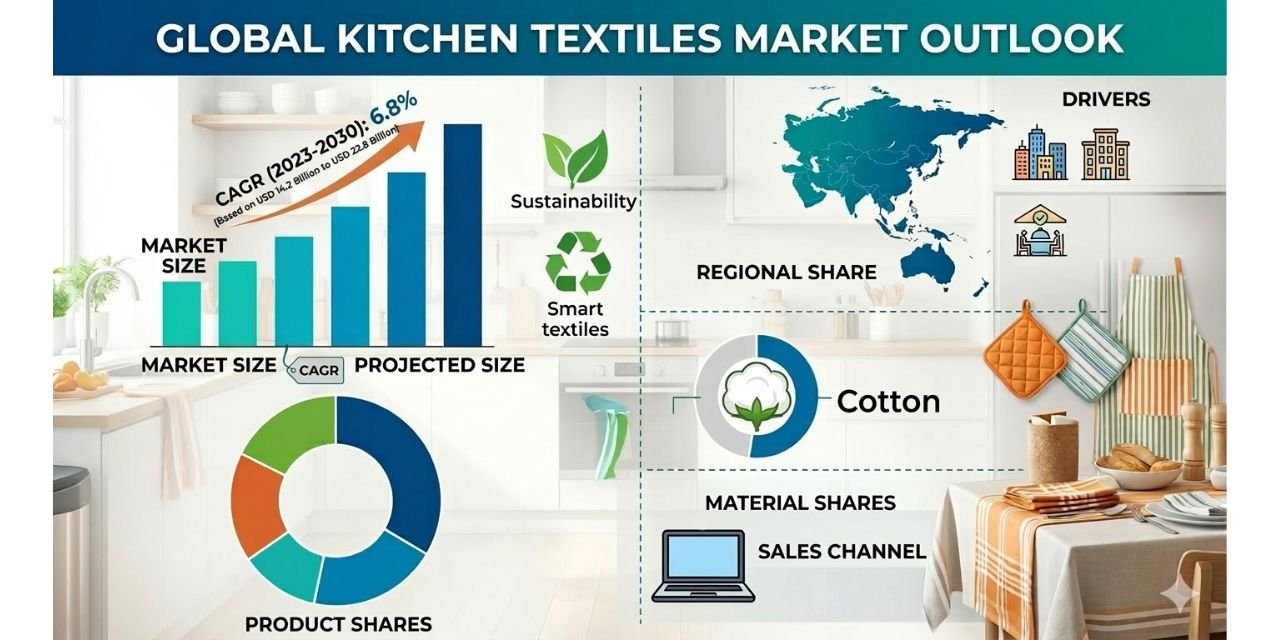
The global kitchen textiles market is witnessing steady expansion as demand rises for functional and decorative home furnishing products. Items such as kitchen towels, aprons, potholders and table linens continue to gain popularity among households and the hospitality sector.
According to recent industry data, the market was valued at USD 14.2 billion in 2023 and is projected to reach USD 22.8 billion by 2030, registering a compound annual growth rate (CAGR) of 6.8 percent between 2024 and 2030.
Growth in the sector is largely driven by increasing urban households, rising home décor spending and the continued recovery of the global hospitality industry.
Market Growth Outlook
The kitchen textiles industry has shown consistent growth over recent years as consumers invest more in organised and aesthetically designed kitchen spaces.
Market projections indicate the sector will expand steadily through the decade:
-
2022: USD 13.4 billion
-
2023: USD 14.2 billion
-
2024: USD 15.1 billion
-
2025: USD 16.2 billion
-
2026: USD 17.3 billion
-
2027: USD 18.6 billion
-
2028: USD 19.9 billion
-
2029: USD 21.3 billion
-
2030: USD 22.8 billion
Between 2023 and 2030, the industry is expected to grow by USD 8.6 billion, representing nearly 60 percent overall market expansion.
Key factors contributing to this growth include the rise of urban households, increased home renovation spending and improving hotel occupancy rates worldwide.
Product Segmentation Trends
Kitchen textiles consist of several product categories, each contributing differently to market revenue.
-
Kitchen Towels: 34 percent market share
-
Aprons: 21 percent
-
Table Linens: 19 percent
-
Potholders and Oven Mitts: 17 percent
-
Dishcloths and Others: 9 percent
Kitchen towels remain the dominant category, generating over USD 5.5 billion annually.
On average, households own 12 to 18 kitchen textile items, while replacement cycles vary. Professional kitchens replace towels every three to four months, whereas households typically replace them every eight to twelve months.
Material Preferences
Material selection remains a critical factor influencing performance, durability and sustainability.
Current market share by material includes:
-
Cotton: 52 percent
-
Polyester Blends: 23 percent
-
Linen: 11 percent
-
Microfiber: 9 percent
-
Bamboo and Eco Fibres: 5 percent
Cotton remains the leading material due to its high absorbency, durability across hundreds of wash cycles and strong consumer preference for natural fibres.
However, eco-friendly alternatives such as bamboo textiles are growing at around 9.4 percent annually, reflecting increasing sustainability awareness among consumers.
Regional Market Dynamics
Regionally, Asia-Pacific leads the global kitchen textiles market with a 38 percent share.
Market distribution by region includes:
-
Asia-Pacific: 38 percent
-
North America: 26 percent
-
Europe: 24 percent
-
Latin America: 7 percent
-
Middle East and Africa: 5 percent
Growth in Asia-Pacific is supported by rapid urbanisation, expanding middle-class populations and strong textile manufacturing hubs in countries such as India, China and Bangladesh.
Meanwhile, North America leads in premium kitchen textile spending, with households spending approximately USD 85 to USD 120 annually on kitchen linens.
Retail and Distribution Trends
Consumer purchasing behaviour has increasingly shifted towards digital platforms.
Sales distribution across retail channels shows:
-
Supermarkets and Hypermarkets: 39 percent
-
Online Retail: 27 percent
-
Specialty Home Stores: 21 percent
-
Department Stores: 9 percent
-
Other Channels: 4 percent
Online sales have grown significantly, rising from 16 percent in 2020 to 27 percent in 2025, highlighting the increasing importance of e-commerce in home textile retail.
Factors Driving Demand
Several key trends are contributing to rising demand in the kitchen textiles sector:
-
Increased home cooking frequency globally
-
Expansion of the hospitality and restaurant industry
-
Growth in kitchen renovation and home improvement projects
-
Rising consumer awareness around sustainable fabrics
-
Affordable home décor upgrades through textile accessories
Kitchen textiles offer a cost-effective way for consumers to refresh kitchen interiors, typically costing USD 25 to USD 60 per purchase.
Manufacturing Costs and Margins
Production costs for kitchen textiles are distributed across several components:
-
Raw Materials: 42 percent
-
Labour: 24 percent
-
Manufacturing Overheads: 14 percent
-
Packaging and Logistics: 10 percent
-
Marketing and Distribution: 10 percent
Average manufacturing margins range from 12 to 16 percent, while premium brands can achieve margins between 20 and 24 percent.
Efficiency improvements in textile production have also helped reduce waste, lowering manufacturing costs and improving profitability across the sector.
Future Outlook
Looking ahead, innovation and sustainability are expected to shape the future of the kitchen textiles industry.
Key trends expected by 2030 include:
-
Eco-friendly textiles reaching 18 percent market share
-
Smart textiles with antimicrobial features growing at 8.5 percent CAGR
-
Reusable microfiber products reducing paper towel usage
-
Rising hospitality demand as global travel expands
-
AI-enabled manufacturing improving production efficiency
If current trends continue, the market could surpass USD 25 billion by 2032, reinforcing the long-term growth potential of the home textiles sector.