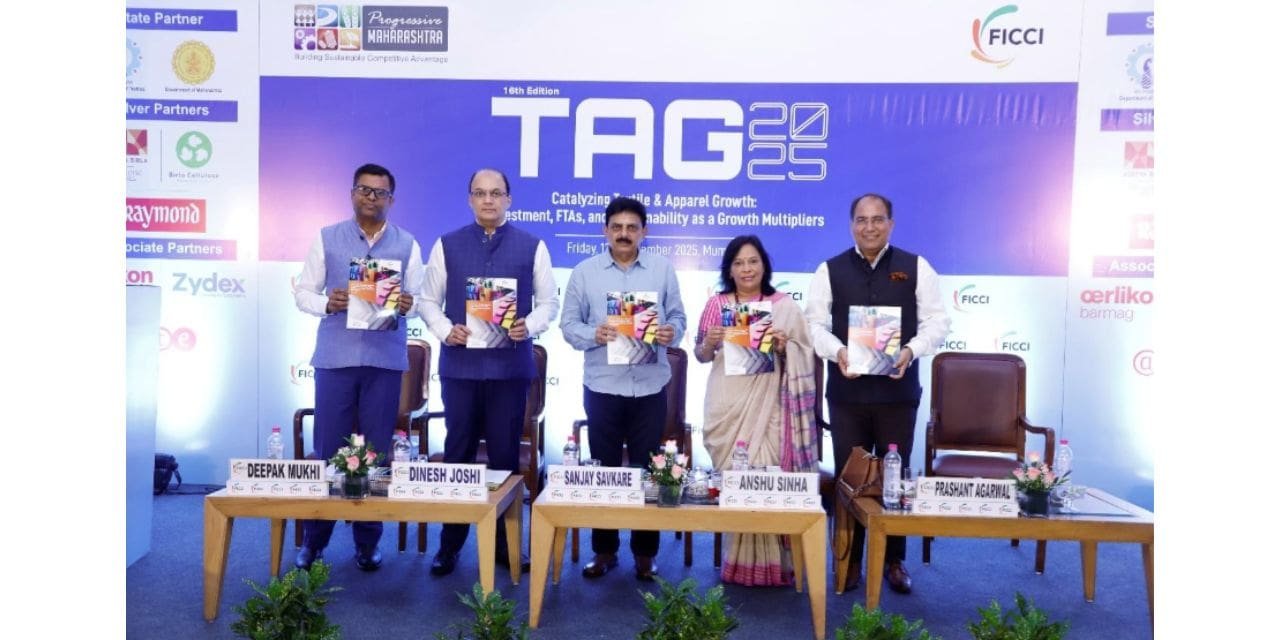
At the FICCI TAG 2025 Annual Textile Conference, Shri Sanjay Savkare, Minister of Textiles, Government of Maharashtra, unveiled the annual FICCI–Wazir Advisors report “Catalysing Textile & Apparel Growth: Leveraging Global Opportunities.”
Shri Savkare announced that the state is working on establishing six Technical Textile Parks one in each revenue division to position Maharashtra as a hub for technical textiles. He emphasized that the government is focused on attracting domestic and foreign investments while extending support in skilling, R&D, and infrastructure development to create a globally competitive ecosystem. A dedicated task force has also been set up to invite stakeholder inputs for boosting export competitiveness.
Ms. Anshu Sinha, Principal Secretary (Textile), Government of Maharashtra, highlighted the importance of industry–academia–government collaboration to strengthen Maharashtra’s leadership in textile manufacturing, particularly in sustainable practices and innovation.
Mr. Prashant Agarwal, Joint MD, Wazir Advisors, presented insights from the report. It noted that global textile & apparel trade reached US$ 893 billion in 2024, growing 5% YoY, while the global apparel market stands at US$ 1.8 trillion and is projected to reach US$ 2.3 trillion by 2030. India’s domestic market is valued at US$ 184 billion, with exports of US$ 37 billion in FY25. However, challenges remain, particularly due to newly imposed 50% US tariffs, compared to lower duties for Bangladesh and Vietnam.
The report underscores garment-led investments as the most powerful lever for India’s next growth phase. Forward integration into apparel manufacturing can drive value addition, large-scale employment, and end-to-end sourcing competitiveness. Key enablers include FDI inflows, PLI schemes, and PM MITRA Parks.
The study further stresses the twin imperatives of innovation and sustainability—from smart textiles and eco-friendly materials to digitized supply chains and scalable green manufacturing practices. While India retains factor cost advantages, the report cautions that weak R&D and absence of FTAs with major markets remain bottlenecks.
The Way Forward: The whitepaper recommends diversification beyond the US market, infrastructure upgrades, policy stability, stronger R&D, and sustainability integration across the value chain. With investment-led growth, global alliances, and innovation, India can position itself as a leading global sourcing destination by 2030.